Billets-Doux
A short story about honeymooning in historic Charleston

Going back through the archives, I found my first published short story in the double issue of the St. Andrews Review in 1990. The issue also boasted an excerpt from a play “The Terrace of the Leper King” by Yukio Mishima, so I was in fine company, including some poetry from Ron Rash. Hope you enjoy.
She sits naked in a green leather wingback chair, her long legs tucked beneath her, as she begins a postcard: Dearest Dreama…
Dreama Honeycutt shivers in the chill of the air conditioner and in her own delight.
Our weekend in Charleston was so wonderful. I requested the best room in the house just for us.
They found perfection waiting for them. Chilled champagne, chocolate mints on fluffed pillows, a four-poster bed with lace canopy, guest stationary. The champagne is half-gone by the night stand, the bubbles stilled. She’ll save the cork as a souvenir. The rich candy melts on her tongue as she writes, And our lovemaking...
Dreama chews the tip of the pen. What would he write?
Dwight Jenkins is still asleep. His sweet mouth is open, her hair mussed like a little boy’s. The sleeve of his t-shirt is hiked up his arm, revealing the tattoo he is embarrassed to sport twenty years since service. The triceps is inked with a mermaid, her seaweed-green hair tousled against his pale skin.
Not knowing what Dwight would say, she puts the postcard aside and dresses. Dwight will probably sleep late after the long drive down last night. She can take a walk, having the morning to herself.
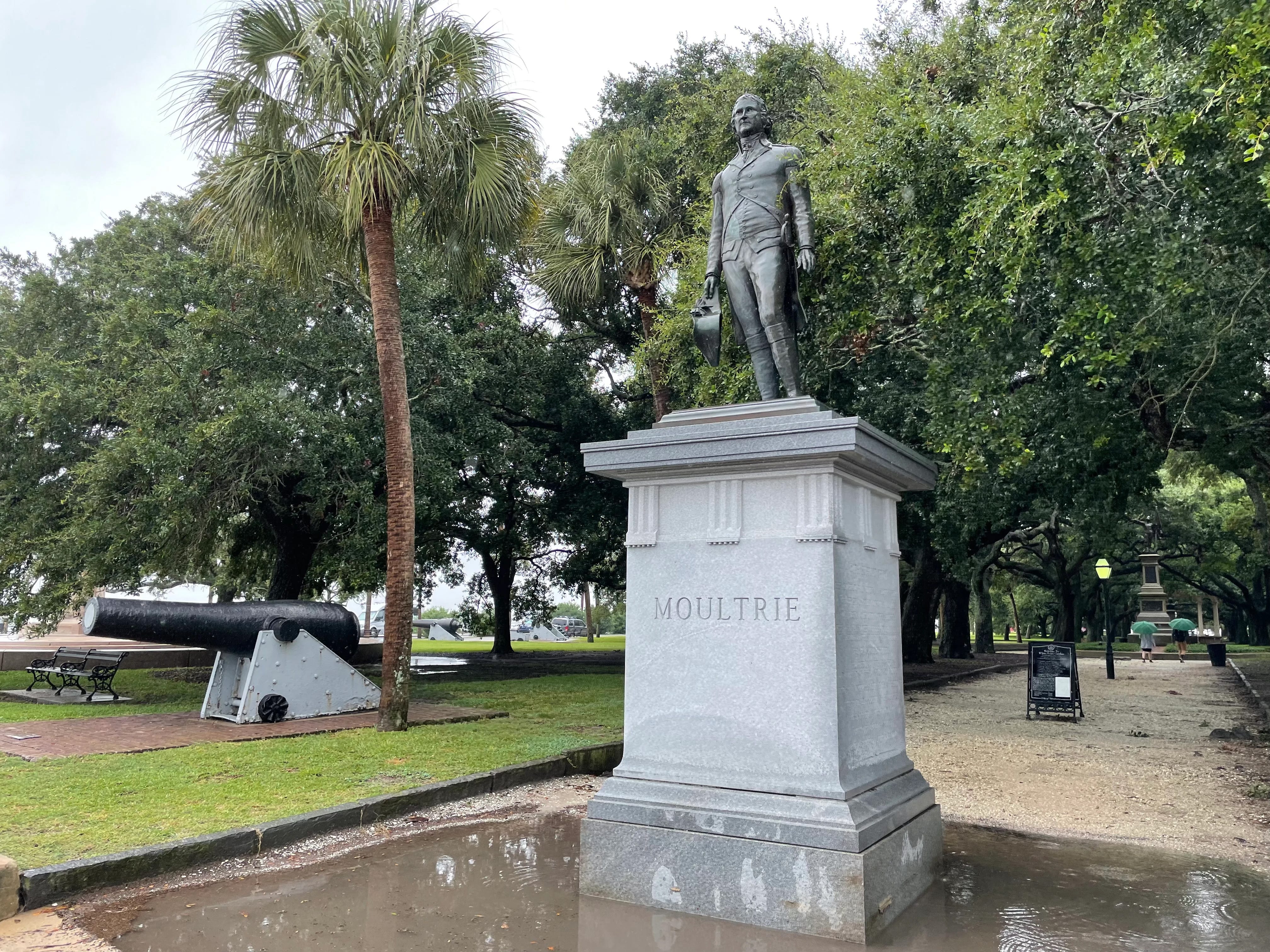
The air in the courtyard is heavy with the fragrance of the magnolia’s drooping flowers. All the guests staying in the former carriage house are asleep. She crosses the street into the seaside park. Old guns still aim at the island in the harbor, the first famous target of that old war. The cannonballs are cemented into neat pyramids. Statues of men with sabers and long rifles stand at each corner, mute sentinels guarding gallantry, sacrifice, doomed struggle. Spanish moss waves from the trees like tattered flags.
“I could make you a uniform. It’s not like I can’t sew,” she said when Dwight mentioned his Civil War hobby. At first Dreama though he meant he dressed up in re-enactments. As a girl, she once saw men wage make-believe war in a cow pasture. They slept under canvas tents, made johnnycake on cookfires, played “Dixie” on plaintive harmonicas. Her class had taken a field trip, fourth-graders marching through the battlefield.
“You could wear the plumed hat of a cavalryman,” she said. “I could be your Southern Belle.”
Dwight blinked his blue-gray eyes. “You don’t have to pretend. You’re not Scarlett, my dear.” he laughed.
Dwight does not dress up in the past. He is a student of obscure skirmishes rather than large campaigns. Driving the interstate, he suddenly pointed into the distance. “This exit, go left a few miles, there’s a battlefield, a marker where Stoneman’s raiders rode down a rag-tag bunch of Rebs, farmers mostly who didn’t like their barns being burned down.”
Dreama took his word, though all she could see on the horizon were overpasses and towering gas signs.
Yesterday, Dwight pointed to an approaching line of headlights. They watched the military convoy pass for miles. Helmeted soldiers rode in pairs in camouflaged Humvees. Transport trucks rumbled along the right lane, canvas tops flapping in the wind. Thunderheads swelled the western sky where the troops seemed headed.
“I hope it doesn’t rain on them,” Dreama said. She was thinking of the National Guardsman she had dated before Dwight. She slept alone every third weekend while he was on maneuvers. Later he admitted he was seeing someone else.
“Clear skies ahead,” Dwight said. “Don’t you worry.”
He had planned their first weekend out of town, making reservations and mapping out the historic sites they must see. Dwight promised to show here where the war really started. Last night after checking into their room, they went for a walk along the seawall, but it was too dark to see the famous fort three miles out in the harbor.
“They fired the first shot early in the morning,” Dwight lectured. “Not here actually, but up on Cummings Point, then Fort Moultrie joined in. Beauregard had forty-seven mortars and howitzers. They hammered the place non-stop for nearly two days before the Yanks surrendered. Four thousand rounds and nobody got killed.”
They strolled by a cannon aimed toward the unseen island. A black couple perched on the barrel, their mouths straining in a deep kiss. The girl’s ankles were demurely crossed. The boy kicked his unlaced sneaker against the cast iron.
The black kids are gone this morning. Sun glints off the choppy bay. Dreama has to shade her eyes. A jogger pads behind here. Drops of perspiration fall from his arms like hot rain on the sidewalk. Dreama breathes in the salt air, the smell of sweat.
From the Battery, she ventures into the narrow streets of the old city. Sidewalks scattered with broken palm fronds lead past shuttered windows, brass-fitted doors. From behind the brick walls, she hears a baby cry, the yap of a small dog. She smells coffee and bacon, magnolia blooms, the sea. She peers through iron gates into verdant courtyards. A man sits in a small green jungle, rattling his morning newspaper.
The mailman is already out on his rounds. He wears a pith helmet, short sleeves, blue shorts, calf-length hose — the same clothes Dreama wears to work back home. She wants to say something when he goes by, but she is out of uniform. She is on vacation.
Actually, she had met Dwight, delivering his mail. Everyday, she stopped by his insurance office with a stack of bills, claims, policy cancellations. He eyed her long legs whenever she wore the blue shorts. Flustered by his attention, Dreama had asked about those charts he was always frowning over.
“Actuary tables. They tell the insured when he can expect to die. Very accurate,” Dwight smiled. “Did you know insurance used to be outlawed in the Middle Ages. It was considered gambling on a poor sailor’s life.”
Over dinner, Dwight told her he had served as a gunnery assistant on a battleship. Before computers or pocket calculators, the Navy taught him to use a slide rule to calculate trajectories of projectiles, how far a shell would carry before it met its mark.
Funny, now he calculates his clients’ lives, Dreama thought, but knew better than to say aloud on a first date.
The mailman works his way down the street. At each house, he sorts through his leather sack. Junk mail makes up the bulk of her deliveries as well. It’s the letters that are the best to slip in the box, They give the job its real weight, but people don’t write like they once did. Her mother used to send letters, filling pages of lined notebook paper with a crabbed Palmer script, right up until her death from cancer. Now, holidays and birthdays, Dreama’s sister in Florida sends greeting cards. “Found anyone special yet?” Sis always draws a smiley face.
The carrier stops beneath a Confederate flag draped over the doorway. His blue uniform suddenly strikes her as out of place. Did the mailmen every wear gray, delivering the news from Bull Run, Gettysburg, Appomattox at last?
Dreama stops at an oak door, pushes the brass lid of the mailslot. Her fingers slide in imaginary condolences, a wax-sealed envelope perhaps, addressed with the flourishes of an old-fashioned quill.
Dear Mrs. Jessup, it befalls us the sad duty to inform you of the death of your gallant husband in the noble cause. Capt. Dwight Jenkins died from wounds suffered in a courageous assault upon impregnable enemy positions. Be proud to know he carried our banner to the crest of the hill before he fell.
The brass slot falls back in place. The door opens.
“Oh, excuse me.” Dreama steps back.
An old woman stands on the threshold. A liver-spotted hand clasps her robe’s frilly collar tight at the hollow of her throat.
“Oh my God. You have some word?” The woman asks.
“Sorry,” Dreama tries to say. The sound starts as a hum in her throat but won’t come out between her teeth.
“Don’t just stand there!” The woman shrieks. “Have you found him yet? Tell me!”
The woman’s look is so awful, Dreama can’t meet her eyes. She looks past the woman’s trembling head at an old clock ticking on a highboy, at a hardwood staircase, at a man in pajamas running down the steps. He gently takes the woman’s elbow and pulls her inside. “Would you please go away,” the man says. “Please leave us alone.” The door closes.
Dreama walks fast, her face burning. She hurries past the high houses and the lives locked within.
“Where have you been?” Dwight sits in the wing-back chair, wrapped only in a towel after his shower. The sideboard is set with a breakfast tray, croissants, cheesecake, coffee, crystal goblets of orange juice.
“I went for a walk,” Dreama says. “I thought you’d still be asleep when I got back.”
“I could get used to the Life of Reilly here. You could be the Queen of Sheba. Roll?” He offers her a croissant split and smeared with marmalade.
She shakes her head. He takes a big bite, brushes crumbs from his unshaved chin.
“You better eat up. I got a big day planned for us.”
Still chewing, Dwight goes into the bathroom. She hears the quick bursts of the faucet, the squirting foam from the can, the scrape of the razor over his face. The leather chair is damp where Dwight was sitting. Dreama stands in the middle of the room, crossing her arms against the chill of the air conditioner.
“Do you think Southern hospitality is a lie?” she asks loudly.
“What are you talking about?” Dwight answers from the bathroom.
“I mean people don’t seem all that friendly down here. I was walking along the street this morning. This woman opens her door and starts screaming at me. It was so strange.
“Probably an old blueblood, doesn’t like tourists poking around her old house.”
“She thought I had some news for her,” Dreama says. “She wanted to know if I’d found him yet.”
Who? Dwight doesn’t bother to ask. The faucet blasts again. Dreama sees her postcard on the table beneath a half-drunk glass of orange juice. She rescues it from under Dwight’s glass, but a ring has soaked through the card, smearing her unfinished message.
“Dwight, if you were going to mail me a card, what would it say?”
“What?” Water rushes in the sink.
“I said if you were going to send a postcard, tell me what you would write.”
“I don’t know. Wish you were here?”
She tears the ruined postcard in two, and writes in her head: Dearest Dreama, That day I felt I could walk forever with you by my side. We picked out the house we would live in when we moved to the city. We knocked on the door and they welcomed use inside because they knew how much in love we were.
Their sightseeing begins inside a mansion inside the Battery. They join a quiet group of Japanese, waiting in the front parlor for the tour to begin. The guide is a silver-haired matron. Bifocals hang on her bosom, hung from a strand of pearls. She puts the spectacles on her long nose. “We request no pictures please. Postcards are on sale at the backdoor.” The Japanese nod their heads when she points to their Nikons, wagging her finger.
“Follow me please.” She takes them into the sitting and dining rooms. Priceless china figurines crowd the mantels. The walls are hung with portraits of mutton-chopped men, oval-faced women.
“These are the original owners. Their descendants still own the house and make their home in the living quarters on the top floor,” The guide says in a practiced voice.
Dreama wonders if they descended the stairs at night, walked through the darkened rooms of their ancestors. She can imagine the people who once lived here. They listened to recitals of high-strung violins, mournful cellos filling the gracious rooms. They sat in leather chairs, feet slippered in velvet. They drank fine teas in bone china that delicately chimed when tapped with the silver spoon.
On the second floor, the guide points out the library with its Audubon folios, the snuff box once owned by Napoleon’s field marshal. Books bound the Moroccan leather line the cherrywood shelves. Dreama spies the parchment on the writing table, the quill in the ink stand. There is no plume to the feather, the paper is yellowed, the ink turned brown with age.
Dearest Dreama, Idly I pulled down a book in the library while waiting for you to come down. I imagine you in your best organdy gown with pearls adorning your white neck. Your silk fan wafts the perfumed air. You curtsey, I bow. Forgive your gentleman caller, but I think only of sweeping you in my arms, carrying you back up that stairs.
On the balcony, the guide waits patiently for stragglers before resuming her recitation. She points to the fort in the harbor, flying its tiny striped flag. In her uninflected voice, she explains how the family watched and cheered the shelling from this vantage point.
“Just like the Star Spangled Banner,” Dreama says.
“Wrong war, dear,” the woman says.
“The first shot came at 4:30 in the morning,” Dwight mutters.
“That’s correct, sir. Family correspondence makes mention of the long night waiting. If there are no further questions, our tour concludes here. Please continue back down the stairs and left to the door to exit the house. We thank you for coming.”
Dwight leans over the iron railing, his blue-gray eyes trained on the fort. “It must have been a real fireworks show.”
“Do you ever pretend things,” she asks him. “Like you’re someone who was there, the man who lit the fuse.”
“No.” Dwight shakes his head. “I just like to see where things happened.”
Outside the house, the Japanese board a buggy tour. Dwight decides against such a ride after counting the money in his wallet. The rest he stashed in a dirty sock in a suitcase at the room. “I suppose I could get more if we find a bank.”
“Let’s just walk, Dwight. I could walk here forever.”
Everywhere Dreama notices the Spanish moss dangling from the thick trees. She picks some from a low branch, runs the strange gray beard through her fingers.
“Wouldn’t this be pretty worked into a wreath? I could put this on the door to the condo.”
“No, it would freeze where we live.” Dwight frowns.
“It might not,” she insists. “A wreath would look pretty, Dwight.”
Shaking his head, he picks the strands from her fingers. Dreama has rearranged everything in Dwight’s condo, made it look nice. Perhaps he resents this although he has never sad so. Maybe he doesn’t want their relationship advertised on his front door.
At the old market where slaves were once sold, vendors have set up a flea market: tie-died t-shirts, Confederate flags, driftwood carvings, crocheted baby clothes. Dwight buys a Charleston shirt with a big red heart instead of the word “love.” For Dreama, he buys a basket woven by a Gullah woman. The church tower tolls out twelve chimes of a heavy iron bell. The sun is hot; the streets are filled with people in sunglasses, shorts, sandals. On King Street, they window-shop the specialty stores along a hotel facade: chocolates, lingerie, men and women’s clothes. These are the fashions Dreama has seen in slick magazines.
She catches Dwight gaping at a mannequin in a black lace teddy. Dreama knows she’s no beauty. Her hair is brown, cut short. Her breasts are nothing. Dwight’s fancy would hang like a dishrag on her coathanger frame.
“It’s air-conditioned in there. We could go in, look around,” he suggests.
“No,” Dreama is suddenly embarrassed. “You wouldn’t like shopping with me.”
In his tank top, cut-off shorts and sandals, Dwight looks less like an insurance salesman on vacation, more like a sailor on shore leave. Dreama wishes she had known him when he was in service. She could have written him letters, told him not to ruin his skin with that ugly tattoo. But, at least, it’s not a woman’s name written there forever.
They trudge toward their room. King Street’s boutiques and shop windows give way to old townhouses and tiers of porches pointed to the sea winds. Dreama recognizes this street as the one she walked this morning.
Dwight grabs Dreama’s arm as a sedan lurches out of a driveway right in front of them.
“Hey watch it, bud!” Dwight shouts. “You want to kill somebody?”
An elderly gentleman clutches the wheel, trying to turn his stiff neck far enough to see behind him. In the passenger seat, an old woman stares straight ahead, fingering a long strand of pearls over her flat chest. They are the same couple Dreama saw earlier at the door. Instead of nightgown and pajamas, they are dressed in mourning clothes.
“I’m sorry,” Dream whispers. The old woman cannot hear her.
The car horn blares. The old man waves them back. Dreama and Dwight are reflected in the passing windows, their red faces like balloons. She feels the heat of the exhaust pipe sigh across her legs. The sedan backs into the street and lurches off, spewing a cloud of diesel fumes.
“Damn snobs. They act like you’re not there,” Dwight says.
“Can’t you see they’re upset?” Dreama says.
“What?” Dwight stares at her. “We’re the ones who ought to be upset. They about ran over us.”
She wasn’t sure before, but now Dreama understands. She points to the door where the wreath hangs. Chrysanthemums and tiny American flags, a pale ribbon.
“Somebody’s died, Dwight. Have some respect.”
“How the hell was I supposed to know?”
“People live here. Keep your voice down.” She glances at the houses, afraid someone is looking. No curtain parts, no door cracks open.
These are not tacky people, Dreama thinks. They do not yell in the streets like a man with a tattoo and a skinny woman with a basket of cheap souvenirs. They wait upstairs. The real inhabitants will come down after the tourists are gone. Their lives are gracious, seemingly untouched behind their historic doors and walls.
I wonder who she lost, Dreama thinks, as they walk back to the room in silence.
Dwight decides against the boat ride around the famous fort in the harbor. The tour takes four hours under a broiling sun and Dreama reminds him she gets seasick easily. Instead, they will go to Fort Moultrie.
They drive out of the city, crossing the James River on a suspension bridge bowed to let ocean-going ships pass underneath. Dreama marvels at the cables strung like a harp. At the crest of the bridge, she can see the warships at Patriot’s Point, the aircraft carrier big as a shopping mall.
“Don’t you want to see the ships?” Dreama elbows Dwight.
“No siree. After a year in the South China Sea, I’m not about to pay money to set foot on one.”
One war is not the same as another, she thinks.
The highway heads north to the beaches. They pass no historic districts, only shopping centers, fast food restaurants, convenience stores. These are people more like us, Dreama thinks. Women with kids push grocery cars through parking lots, men in shirt sleeves and ties eat lunch after selling insurance, used cars, real estate. Parking lots and stores give way to salt marshes and marinas. Beach cottages spring up in ramshackle rows. Through breaks in the dues, Dreama catches glimpses of the ocean.
At the Fort Moultrie parking lot, a fluttering American flag slaps the lanyard against the metal pole, a pinging sound regular as radar. South Carolina and Confederate flags wave from neighboring staffs.
Inside the visitors’ center, Dreama heads for the restroom. She splashes cold water on her dry face. Without any make-up, she can’t see how Dwight can bear to look at her. She’ll buy some cold cream before they go back to the room.
Dwight waits impatiently by the exit doors, already having gone through the hall of glassed displays. He waves to her to hurry along.
“What’s in the exhibits?” she asks.
“Old stuff they fished off the beach -- shells and junk, rusted spoons.” Dwight opens the door for her. “Out here is where they fought?”
Their shoes crunch across a walk of crushed shell. They descend through an arch in an earthen wall, into the past.
Dwight carries a pamphlet for a self-guided tour. The oldest parts of the fort date to Revolutionary times, Dwight says. They see the magazine rooms where gunpowder was stored, empty chambers with whitewashed walls. Dreama expects a sharp tang in the air, but it smells musty like a basement. Brick walls give way to metal bulkheads. During the ‘40s, the Navy manned these underground bunkers, listening offshore for the echo of German U-boats.
“Rooms are preserved behind glass, depicting life in these quarters during 1942-45,” Dwight reads aloud. His voice booms along the metal walls.
They pause at a plexiglass-enclosed room with scarred desks and swivel chairs. An Eisenhower jacket with divisional insignia hangs in the corner. Betty Gable peeks over her shoulder from a poster taped inside an open locker. On the nearest deck are Life magazines, an old-fashioned telephone, an ashtray with snuffed-out cigarettes, a pack of filterless Camels. A loudspeaker plays snatches of Benny Goodman, a radio announcement about coastal blackout, radar blips, bursts of ancient static.
Dreama sees a letter half-finished on the desk. She presses against the glass, trying to make out the message, imagining whoever was writing it is about to return. Was it a man on duty? Or perhaps the man was killed before he could give his love to his mother, his wife, his sweetheart.
Dwight leans over her shoulder. Reflected in the breath-smudged plexiglass, they look like the old couple in the doorway. Dreama has her hand spread under her throat like the woman holding the frilly collar of her nightgown. Tendons are starting to show on the backs of her hands, where liverspots will paint her skin in years to come. Dwight grows decrepit in this light. His hair recedes, the skin under his chin sags and wattles. He is the man in pajamas, squinting into the past.
“What would you write me,” even her voice croaks and falters, “if that was your letter on the desk?”
Dwight’s lips move close to her hear. “This.” His hand squeezes her breast. The spell is broken. She pulls away from him.
“Let’s go back,” she says.
They retreat along the bright hallways of the bunker into the corridors of older wars. Her sandals, his flip-flops slap against the flagstones. In the darkness, children scream and shriek, pretending bombardments.
Sunlight explodes overhead, and the cries of the children are lost in the crash of the surf. They are outside the fort near an unpainted beach house. Dreama blinks at white sheets flapping on a clothesline.
“Must have taken a wrong turn,” Dwight says.
But Dreama doesn’t want to go back. She picks her way across a patch of sandburrs, a miniature minefield. A rock stubs her toe, and she swears out loud, unladylike.
“Dreama, wait!. What’s the matter?” Dwight catches up to her, spraying sand with his flip-flops.
“Nothing,” Dreama shakes her head.
Perplexed, he scratches at the tattoo on his arm, now sunburned after a day uncovered by a shirt sleeve. The mermaid’s green hair, the scales of her tail, the lewd grin are highlighted against red skin.
“I hate that tattoo,” she says.
“So do I.. Ever since the day we steamed out of Manila.”
“You’re never romantic,” she says. “Why can’t you be romantic?”
Dwight looks for his answer at the fortress, at the sea, then at his feet. He wants a way out of this moment.
“How about a walk on the beach?” he mumbles.
They walk in silence against the wind. Sand grinds into her cut toe. Crying would feel good, but her eyes are too dry from the salt air.
“Is that stupid fort out there again?” She shades her eyes against the glare on the waves. Sailboats and windsurfers, brightly colored triangles, dodge across the old target.
Dwight shakes his head. “I still can’t figure out where the first shot came from. Maybe that point up ahead.”
“Enough history,” Dreama says. “Let’s just walk.”
The tide rushes in, foaming at her feet. Resting her hand on Dwight’s shoulder, Dreama lifts one foot, then the other, slipping off her sandals. The bloody toenail stings in the salt water. She splashes through the surf. Dwight stays on the dry beach, but he hangs onto her hand.
It is dark when they drive back to the city, the night wind rushing in the open windows. Lightning flashes over the salt marshes, but there is no thunder. They climb the bridge rising like a lighted harp over the river and the warships. Their room is perfect when they come in: chilled champagne, mints laid on fluffed pillows, white sheets folded down.
They make love without speaking. His tongue and his touch feel strange to her skin. She arches her back on the soft bed. When Dwight is done, she rolls on her side. In the dark, she can make out the white blur of the postcards on the table. Only she knows what they say: perfect and empty.
Dreama knows soon she will sleep, then awake in a strange bed in an unfamiliar place. She will sleep, then awake in Dwight’s bed at his condo. When she leaves him, there will be no long letter, no last word, no need to explain. She’ll go to work, shoulder her bag of mail, make the appointed rounds. She has not lost anyone, Dreama will say to her sister, to anyone who asks. She has not found him yet.
Dwight rises in the darkness over her shoulder. “We saw the fort today. Tomorrow, we can drive out to the plantations. I’ll let you play Scarlett, if you want.”
She closes her eyes, listens for the crash of the waves against the seawall, echoes of the famous barrage.