Housework
A short story of remembrance and tidying up our lives

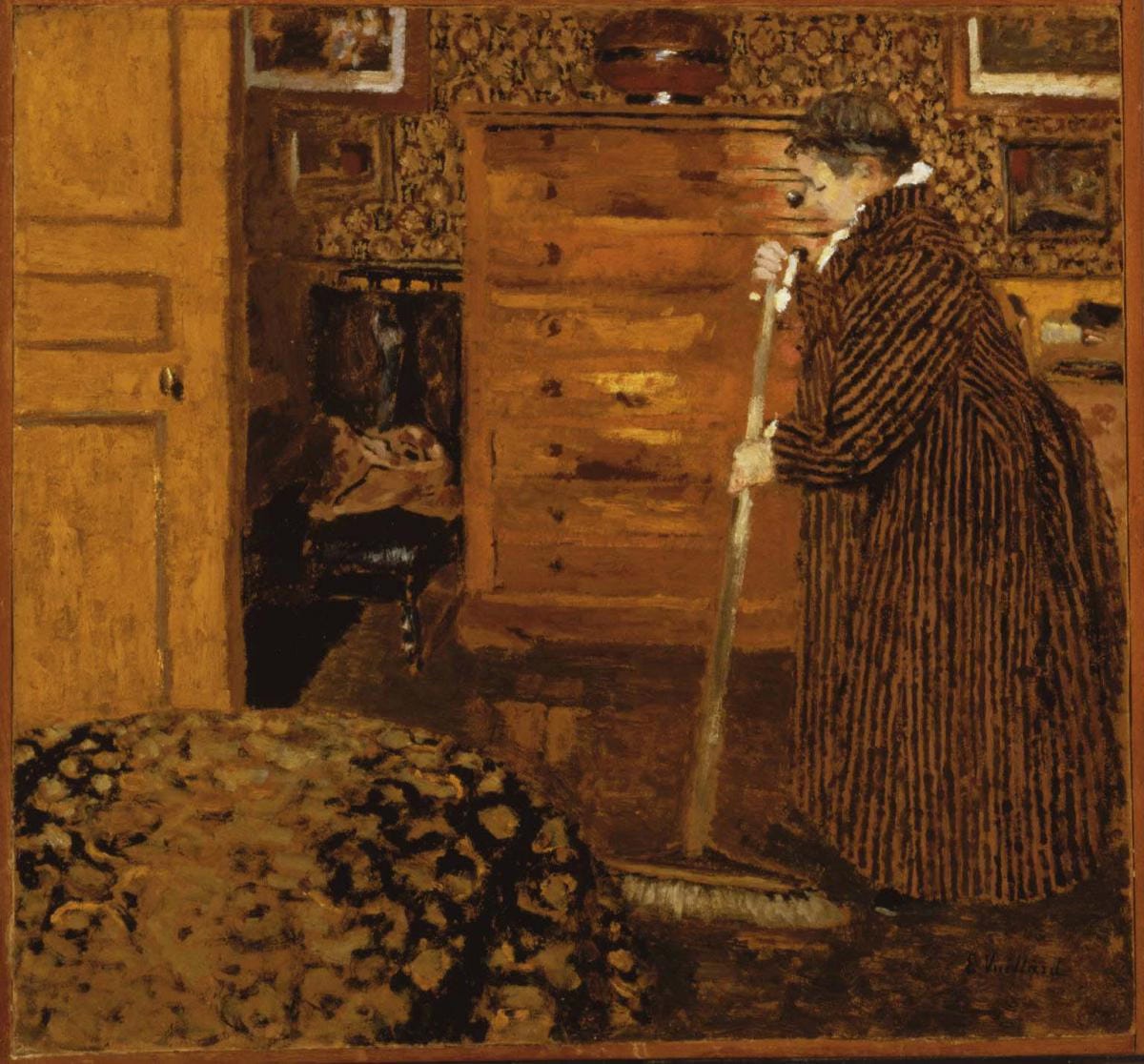
Woman Sweeping, Edouard Vuillard, Phillips Collection
It’s been a busy summer and fall moving my parents into assisted living and watching them settle into the last chapter. I’ve been digging through childhood photos and memories in cleaning out the house. And I’ve been digging through my own archives. This story was first published by the Carolina Quarterly in 1992, involving characters from my novel The Half-Life of Home (2013). Looking it over again, I’ve realized we all have housework, homework, heart-work as we attend our lives and our loved ones.
Broom and mop by the back door, brush and bucket under the kitchen sink, duster and rags stored in the hall closet. Cleaning takes time and tools to knock cobwebs from corners, chase dust balls down steps, scrub soot from parlor walls. A body gets tuckered out when all’s been said and done and needs doing again. After so many years, you’d think spiders and dust and soot would learn. You’d think.
You forget.
Judith does her homework when she visits in the afternoons. She reads poetry aloud: “I bequeath myself to the dirt to grow from the grass I love. If you want me again look for me under your boot-soles.” She underlines the poem with a yellow marker. “You think that’ll be on the test?” she asks.
All I can think of is dirty boots tracking across a clean floor.
Judith’s a bright girl. She’d be almost pretty if she did more with her looks, but she favors the drabbest, darkest clothes. If only she would take off her glasses and pull her nose out of a book once in a while. She gets good marks in school, but she’s got to learn about boys.
Now none of this is my business since Judith’s not my grandchild but belongs to Mrs. Potter over in the next bed. Mrs. Potter has Alzheimer’s and doesn’t know her own kin.
“It started when she began leaving sugar out of the cookies she’d bake for me,” Judith explained. “Then when I turned nine, Grammy frosted my birthday cake, “Happy Birthday Julie.’”
Most evenings, Mr. Potter comes and feeds his wife. Then he turns on this TV game show where all the answers are like questions. He coaxes her to play, to work what’s left of her head. “Geography. You know this one. Capital of Argentina. Don’t play dumb. What is Buenos Aires?”
He keeps after her something fierce.
He told me his wife was once a schoolteacher, so it makes her condition doubly sad. Years of giving out answers and now she can’t even ask the questions right.
Judith must take after Mr. Potter – full of questions. When her grandmother’s asleep, she pulls a chair over to visit. She says she’s going to do her next paper in history class on me.
“We’re supposed to do it with our grandparents, but I’d like to use you, if you don’t mind.”
“I can tell you about when I was growing up, but history’s before my time.”
“That’s O.K.” Judith taps her chin with her pencil. “When were you born?”
“March 5.”
“The Ides of March. That’s when Julius Caesar got stabbed. But I meant what year were you born?”
The figures come to mind, shaped in my handwriting, but I don’t remember off hand how to call their name. I’ve been putting those numbers on paper since I was a little girl, put them on my marriage license, on my Social Security papers, then on the forms that put me bed in this rest home. Everyone wants to know old a body gets.
“1985.”
Judith gives me an odd look. “No, that’s not right. Even I wasn’t born yesterday.”
“Did I say 1985? I meant 1895.”
“Did you know that you were born three years after Walt Whitman died?”
“Yes, thank you, I know.” But I’m not sure about that Whitman fellow. His poems make him sound so messy, like someone who always needs cleaning up after.
At my age, you forget the simplest things: Did you unplug the television when it’s lightning bad? Day before, did it rain or the sun shine? Does mail still come on Saturdays? Did you remember to clean the bathtub, scrub that ring of grime all afternoon but forget to rinse off the soap? Later, at bath time, did you turn on the left-hand faucet but not the right?
That last slip landed me in hot water. Skin scalded on my right foot, along my leg and my hand where I tried to catch myself. Side of the tub about stove in my ribs. It’s a good thing I didn’t break a hip or bust my head.
Foot doesn’t feel right since it got burned. My toes are cold all the time, which makes me sick for my man. Sleeping with Jake Wilder was better than a stack of quilts on a chilly night. I’d curl into Jake’s warm back and legs. We fit snug for years, until the last night, and that I won’t forget. We said good night but it wasn’t one. He tossed and turned, said supper hadn’t set well with him. I fetched him a glass of bicarbonate to settle his stomach. I must have gone to sleep as he sat up a while.
Toward first light, I suddenly bolted, calling his name. He was still sitting up, but Jake’s foot was a block of ice under the clammy sheet.
“Mister, you must dip that in springwater!”
The doctor slides his stethoscope down my nightgown. Every time he pokes me with that cold metal, I catch my breath. The suction on my dry skin reminds me of when I was a little girl riding with my daddy down a muddy road and the sound the horses made, their hooves sucking through the mud.
“Breathe in. Breathe out,” says the doctor. He goes hmmm, hmmm, listening to my side where I fell in the tub.
“We’re still a little tender on that side,” he announces at last.
“That’ll teach a body to take a bath, won’t it?”
The doctor laughs. He unplugs the stethoscope from his head. Must not feel cold to him with the gray hair growing out his ears.
He raises my leg and bends my knee. All the muscle droops from the bone, wasting away the longer I lie in bed. An aide rolls me over every hour, but I still get sore.
“Can you squeeze for me?” he says, lifting my hand.
“Pleased to meet you.” I give him my best handshake. Look at that claw of mine, looks like it belongs to a chicken rather than a woman. My hands never were much to look at, after sixty years of washing dishes and chucking wood into the stove.
I squeeze hard. “Ain’t lost my grip, have I?
“Not yet, Mrs. Wilder, not yet.”
He lets go before I do. The gold pen gleams in his fingers as he writes in his folder.
“Lunchtime,” the black girl sings, wheeling in the meal cart. The doctor stops her and lifts one of the metal tops covering the plates. The stethoscope nearly plops into my lunch while he breathes in the smell.
“Looks good today.” He beams. “Enjoy.”
Mrs. Potter has forgot how to eat. The girl has to spoon puree into her mouth, then scrape up what dribbles down her chin. I’m not much better. The breaded cutlet won’t cut under my fork, and it takes a steady aim to spear a green bean.
After dinner’s done, the white curtain gets yanked around the bed for privacy, but you can smell Mrs. Potter doing her business. “That’s a good ole gal,” the black girl coos like Mrs. Potter was two years old instead of eighty-two.
When the girl comes to collect my tray, she peeks under the bed for my pan. “How about it, Miz Wilder? You need any cleaning after?”
“Mind your own business and I’ll handle mine.”
The past is junk, things lying about, collecting dust until they’re hauled upstairs to the spare bedroom. City woman once knocked at my door, asked if I had any quilts for sale. I’d cut up all them old things to cover the pillows in the parlor. If you can’t use it, junk it. What’s old takes twice as long to clean.
Soot settles all over a house. Lift the lace doily under the oil lamp -- it leaves a black pattern like a cobweb on the table. My mama tatted that lace, and you have to careful to wring out the doily by hand, iron it flat again. The table you polish with oil and lemon juice and cheesecloth. The lamp needs cleaning too.
As a little girl, I’d soap that blackened globe in the sink, daydreaming out the kitchen window while I rubbed wishes on my magic lamp. I’d wish Jake Wilder wasn’t so mean to me at school, wish for a boy to marry me someday, wish for a family, wish that I could travel. Always I’d wish for the future to hurry up and my chores to be past.
And now what would I wish for? The old chores back. The squeak of washing windows. Rugs thumped on the line, raising clouds of dust to make you sneeze. Baking soda and pine oil, starch and soap, polish and shine, these hold a house together in season and out.
Judith combs my hair, what little is left. My scalp hurts like she was scraping me with briars. I’ll bet my head smells too, but I don’t catch Judith wrinkling that pug nose.
“Do you ever use hair coloring?” she asks.
“Why law no! You look and tell me if you find one gray hair up there. My mama’s hair was like this, jet black to the day she died.”
“Grammy used to dye hers silver,” Judith says. “I guess she started out a blonde.”
“Hair’s important. Men like hair on a woman. John used to pull my black braids when I was little. And he’d tug on them later too.” I chuckle.
“I’ve got mouse hair.”
“I like it, honey.” I brush her bangs off her forehead. “And you’ll find some who will like it too. A boy.”
“Annnhhh!” Mrs. Potter starts yelling, a baby sound coming out of an old woman. Judith pushes the button to call the nurse, but Mrs. Potter’s yelling louder. Her legs and arms are flailing in a fit.
“Grammy, please. Grammy, stop,” Judith pleads, but she won’t go near her grandmother. She bolts the room to get the nurse.
“You quit that now, Mrs. Potter,” I say.
I sit up too fast and get dizzy. My feet dangle over the side of the bed in a draft cold as creek water.
“Annnhhh!” goes Mrs. Potter.
“Hush now. You scaring folks with that.” Mainly, she’s scaring me.
“Annnhhh!”
My head’s swimming so, I can’t see the floor, then memory starts playing tricks. I’m little again, just turned five, with my feet splashing in the creek that ran beside the house. My older sister May wades into the middle of the current, twists her foot and falls. Her mouth is open, screaming into the air, then gurgling underwater. My feet hurt so bad, I start to cry. Ice water runs through my veins and I’m froze to the spot where I’ll watch my sister drown. Between my sobbing and my sister’s screams, I hear the slam of the screen door and mama running to save us.
The nurse hurries in. Crisp white trousers scuff between her thighs. “Now dear, let’s calm down. I want you to lie down, Mrs. Potter. You too, Mrs. Wilder.”
The squares on the floor are minnows swimming under my bed. My feet are wrinkled as the day they soaked in the creek.
The nurse catches me before I keel over. “Don’t cry. She’s going to be fine.”
“I wanted to help, but it was too cold,” I tell the nurse, same thing I told mama long ago.
You forget how old you are. That comes to mind only at day’s end, sitting by the fire, barely able to keep the rocker going. An old house keeps an old body company, sharing the same complaints. Windowsashes bump in the frames. My old eyes squeak in their sockets when I rub them. The floor settles, beams buckling underneath. Knuckles and anklebones swell. Tongue slips from groove. A warped plank pulls rusted nails from the side of the house. Veins pop out on my legs. My skin turns dry, scaly, spotted. In the corners, spiders are already spinning webs for the next day. The clock ticks slowly on the mantel, and I can hear my heart beating faster.
Downstairs is done, but I dread the upstairs. The beds need changing, the floors sweeping, the rooms airing, but I don’t hardly have the heart. I’ll think of cleaning upstairs another time. I can barely get up these days.
“Open wide, Mother Wilder.”
Eva, my daughter-in-law, has to spoon dinner into my mouth, now that I can’t. It was like my hand’s gone all to sleep, all numb. Last time I tried, spoon fell out of my fingers, applesauce went down my nightie.
“Bitter.” I wrinkle my nose, stick out my tongue. Applesauce tastes sharp like it came from a can instead of a tree.
They gave Mrs. Potter medicine to hush her, but I can still hear her whimpering in the next bed. Mr. Potter is watching “Jeopardy.” He’s still asking the questions to the answers. “Who is FDR? Who is Uncle Joe?”
Royce comes directly from work, his collar unbuttoned, tie loosened. He sets his briefcase on the foot of my bed. He’s worse than Judith about bringing homework.
“I brought some socks for you to wear.” Royce opens his satchel.
“Best not be wool. Wool scratches my feet.”
Royce studies the label. “Wood blend.”
“There’s a pair of Jake’s work socks in the upper drawer of my bedroom. They’re old wool, all the itch worn out. You get me those socks, hear?”
“Mother Wilder, it’s an hour’s drive up to the farm,” Eva says to me, but she’s shaking her head at Royce.
“While you’re up there, Eva, you’ll need to sweep. I’ll bet mice and spiders have about taken over the place.”
“Mama,” Royce sighs. He has that tone in his voice he used to get as a teenager about to backtalk me.
“Clean out the stove too, then lay me a few sticks of kindling so I can light a fire and take the chill off when I get home.”
“We can’t go there now.” Royce closes the briefcase. The locks click under his thumbs. “I’m afraid it’s final.”
“Watch how you talk to me. I’m old but I’m still your mother.”
“Mama, the house has been sold,” Royce says quietly.
“Now wait one minute. Who said you could do that?”
“Power of attorney, Mama, you gave me permission. You needed the money to pay for your care. I’m sorry, we didn’t want to tell you until --“
”Until you could put me away. I’d have fixed my business different if I’d known.”
“Mother Wilder.” Eva daubs at my chin with a napkin, a little roughly. “You’re ninety-two and you know you’re getting too old to be by yourself. You fell in the bathtub, remember?”
“I remember, all right.” I swat her hand away. “I remember my mother’s side all swelled up with liver cancer. I didn’t go sell her house.”
Royce and Eva give each other these guilty looks, and I know it in my son’s eyes what he’s still not telling me, what the doctor and the nurses and the ache in my side secretly know: my business is fixed already.
“Mama.” Royce takes a deep breath then lets it go. “That was a long time ago before nursing homes.”
“At least, I was a nurse to my mother. I didn’t get food all over her face.” I wipe my chin.
Eva’s eyes well up with tears. It was a terrible thing to come out of my mouth, but I feel old and sick and scared. I can’t find a kind word to say. I shut my mouth, but my lips keep twitching.
The quiet between us is terrible. The bed over, Mrs. Potter’s whining and Mr. Potter’s muttering “What is Mother’s Day? What are roses?”
You make your bed, then you lie in it. Ever so often, the mattress needs turning to keep the body from making its own rut. Unplug the electric blanket, stack the quilts and pillows on the floor, strip the sheets. I lift the mattress from the sagging springs. The tired old foam collapses between the wall and the bedframe.
My mama’s featherbed made fun cleaning when I was little. She’d pull it onto the floor and let me turn cartwheels and somersaults to fluff up the down. Later, when she wasn’t able, I turned her in that bed. Mama was light as a feather, limbs brittle as kindling under the counterpane. I’d lay her down gently, but she’d sink into the bed like she was dropping into the grave. She whimpered with sores on her heels and elbows. Lie in one place too long and no bed’s soft enough.
I hoist the mattress back on the springs, fresh side up. After ten years, the bed still holds Jake’s impression before the ambulance men lifted him onto the stretcher. I snap out a clean sheet, let it drift down over where our bodies lay together.
Judith got straight A’s in English but C’s in algebra. I tell her she ought to study numbers harder, she’s got words all right.
“Would you rather listen to equations or Emily?” Judith slams her math book and grabs her poetry:
Because I could not stop for Death-
He kindly stopped for me-
The carriage held but just Ourselves-
And Immortality-
“That’s pretty,” I say. I wouldn’t say cheerful, but pretty.
“Emily Dickinson,” Judith says. “I have to write a paper on her next week.”
“You’re good at reading poems. I’ll bet you write them too.”
Judith blushes. It does me good to see color in that child other than black and white.
“Maybe you could read me your poems.”
“They’re not very good,” she says. “I have a hard time with meter and rhyme.”
“What do you write about?”
“Getting old. Losing your mind.” Judith glances at her grammy. Mrs. Potter lies in bed asleep with her mouth open. Only by the slight rise of lace on her nightgown do you know she’s still breathing.
“Does it help?” I ask.
Judith blinks hard like her eye’s caught a speck of dirt or the start of a tear. “I guess so.”
“You remind me of my sister, May. She was a bright one, good with paintings. She’d copy ladies with fans and feather boas from magazine covers. May could picture places you’ve never seen, where people wear sheets and play little harps. It looked sweet as heaven. May’s pictures made you feel sad, but it was a pleasurable sort of sad.”
“I know what you mean,” Judith says. “What happened to May?”
“She passed with the influenza.”
“You think about her now?”
“Sometimes. But I keep busy.”
“How?” Judith presses her book to her flat chest.
“I clean house. Keeps the cobwebs out of my attic.” I tap my head, then twirl my finger in a crazy circle. Judith giggles, then covers her mouth.
I can picture May’s painting hung crooked on the parlor wall. Studying it, I can see sorts of soot collected on the canvas. I get me a rag and a little turpentine and start to scrub. It’s hard to tell what’s paint and what’s dirt, but my sister didn’t make what you’d call a colorful picture.
A black dog bows its muzzle like it could pray, beside an empty cradle. A rose pinned to the footboard has shed its petals over the sheets and floor. Just looking at it, you know too well what happened.
I lost our firstborn, a boy we would have named Jacob, if he’d lived more than a few hours. We had Royce a few years later, but you don’t forget. As for man, his days are like grass: as a flower of the field, so he flourisheth.
Babies and flowers, I reckon.
My rag’s turned black with soot, but I see the dog in the picture turning white. That pup’s not black at all, but white as the first snow. I scrub at the empty pillow until a baby’s head takes shape. Rub harder: the petals of the flower bloom again. Years of smoke, soot and memory had covered the real picture.
Amazing how a little spit and elbow grease change everything.
“Mama, you sleeping? Mama?”
I can almost see Royce through my eyelids before I open hem. My skin’s so thin, I’m scared his kiss might leave a bruise.
“How are you feeling?” Royce smiles.
I work my lips and try to smile back. They get so dry, there’s no spit left in my mouth.
“Thirsty?”
I nod. He fetches me a glass of water with a straw. I don’t hardly have the muscle in my mouth to suck.
“Here, I brought you some candy.” Royce pushes a round drop between my teeth.
I close my eyes but the lids are like paper. I can make out shapes and shadows. Royce is talking with the nurse. I see them at the foot of my bed but they sound miles away.
“She seems more swollen on that side,” Royce says. “Has she been complaining of any pain?”
“I just came on duty.” The nurse checks the chart on my bed. “We’re up to morphine now. Your mother shouldn’t be feeling much of anything.”
“I guess it’s hereditary, liver cancer.”
“Like I said, I just came on,” the woman says. “Since you’ve been here, has your mother voided?”
“Not that I know of,” my boy says quietly.
The candy he gave me is lemon flavored, so tart my mouth puckers. I push the candy out with my tongue.
Reckon it can’t be put off any longer: time to go upstairs. Each step seems a chore in itself. Suds from the bucket slosh on the stairs. I lean on the mop handle for support. It’s a steep climb and I have to catch my breath at the top. The air is cooler up here. A window must be open somewhere with that draft I feel. I set my bucket down, and reach for the string to the overhead light, but the frayed pull snaps in my hand.
A crack of light shines under the door at the end of the hall. I hear something scratching on the other side, whimpering.
I open the door on a white dog panting a long pink tongue. The dog cocks its ears, then barks as if glad to see me. May sits before her easel, paintbrush in hand working over a white canvas. She’s painting the four-poster bed where Jake’s stretched out in boots and overalls. He’s bouncing a naked baby boy who laughs and kicks in the air. ON the other side of the bed sits Mama in her nightgown, brushing out her long black hair. I see her smile at me in the silver mirror she holds. She pats the cover beside me to come sit. The family’s waiting. May’s going to paint our picture in bed.
I stand on the threshold with my bucket of soapy water and my mop. “I’ll be there directly. Let me clean this floor first.”
The door shuts and I feel the dust falling on me in the dark air.
“Good nap?”
I blink in the bright sun. “How long was I asleep?”
“Not long,” Judith says.
We are in the recreation room. Judith’s pushed my wheelchair by the window and pulled up a seat beside me. She leans over and pats my hand, but it almost hurts to be touched.
“They’re cleaning the room right now, the beds and everything,” Judith says. “It’ll be nice when we get back.”
“I like a clean bed.”
“Grammy won’t be there when you get back. They’re moving her to another place. Nothing against you. Pops said she needs more attention. He got mad when he found her tied down in bed.”
“A body ought to get mad if they tie you down.”
“How do you feel?” Judith asks.
“Oh child, I’m not fit to kill.”
Judith laughs with me, and then we fall silent. The window is streaked where the sun shines through. Dust hangs in the air. All of a sudden I blurt right out. “I have cancer, you know.”
“I know.” Judith nods her head, white teeth pressed against her pale lip. “Pops told me.”
“You know, my mother had it too. I had to take care of her, but there wasn’t any medicine for her pain. These things run in the family.”
Judith looks at the television but the sun’s shining so you can’t see the people on the screen. She must be tired of hearing about my troubles when she’s worried about her own grandma. For all she knows, losing your mind might run in her family.
I’m tired too. Judith put socks on me but the wheelchair’s footrest hurts my arches. I believe the bone would break if I stood my full weight on that leg. I look at my wrinkled socks and doze off until I feel my chin digging into my chest.
“Did I fall asleep again? I’m sorry. I’m awful poor company.”
“It’s okay,” Judith says. “You didn’t miss anything.”
“It’s the medicine they give me. I sleep a lot nowadays.”
“Do you dream in color or black and white?” Judith asks. “I read it’s a sign of intelligence if it’s color. Dogs dream in black and white.”
“Color, I reckon. It looks real enough.”
“You remember your dreams? What are they like?”
“They’re a chore, let me tell you. I dream all the time about cleaning house. I about work myself to death every time I close my eyes.”
Judith looks me straight in the eyes. No one has looked me head-on for ages. Royce and Eva and the doctors, they’re always talking to my ear or my eyebrow or the top of my head or the tip of my chin, but never to my eyes. It’s hard. She looking square at me and I find myself looking at her glasses, wondering when that poor girl’s going to clean the dust off those spectacles.
After a moment, Judith checks her watch. “Pops is picking me up at four. The room ought to be done now.”
“Let’s head on home then.” I laugh.
My sock slides off the footrest and my foot hits the hard floor. It’s the first step. I’m ready. No stairs to make me dizzy this time. The hall won’t be so dark. The bed will be made for me.
Judith wheels my squeaking chair down the lighted hallway. The doors are open on either side and all the beds are filled with women in my shape and age, curled under the covers, calling out old names. There’s no rest here, no home.
Back in my room, Judith and an aide hoist me from my chair into the bed again. I must be like a sack of feed the way they lift me. The mattress wasn’t turned. I sag in my same old rut.
Judith laces her cool young fingers in my chicken claws. “I got an A on the history paper we did together. I’ll remember to bring it next time.”
“Don’t forget.” I try to squeeze her hand, but she’s already slipped free of my hold.
The curtain billows all around, the metal rings skittering on the runner, and Judith is but a shadow on the other side. The sheets of my bed smell so clean. When I close my eyes, everything stays white.
Reminiscent of one of my all-time favorite short stories, “The Jilting of Granny Weatherall” by Katherine Anne Porter. Thank you for sharing this. And this line, in particular, is just amazing: “I can tell you about when I was growing up, but history’s before my time.”