Make me a Mountain Man again
Revisiting the paperback behind Robert Redford's "Jeremiah Johnson"

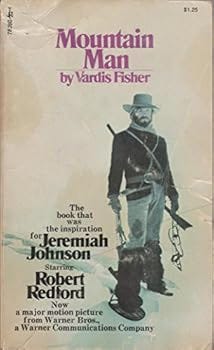
Cleaning out my parents’ house after moving them into assisted living last summer, I’ve come across the forgotten treasures of my youth, including well-thumbed paperbacks that I devoured as an early reader. It’s been an eye-opener, revisiting those reads for the adventure I craved, and seeing things now that I missed earlier.
Vardis Fisher’s novel Mountain Man was first published in 1965, providing the basis for Robert Redford’s epic Western film Jeremiah Johnson in 1972. Redford’s photo in snowshoes on the book’s cover caught my eye browsing the wire racks at the local Eckerd’s drugstore. I was a Boy Scout, age 15, headed that summer to the Philmont Scout Ranch out in New Mexico, following in the tracks of those legendary mountain men.
I’d devoured the movie with its grand backdrop of the Rocky Mountains, the high snows, and the aspen forests. Redford learns the ropes as a tenderfoot trapper, who vendetta against the Crow Indian tribe after his Indian bride and adopted son are killed in a surprise massacre. It was one of the first Hollywood movies trying to accurately depict Native American culture, instead of haphazardly slathering extras in gaudy headdresses and warpaint
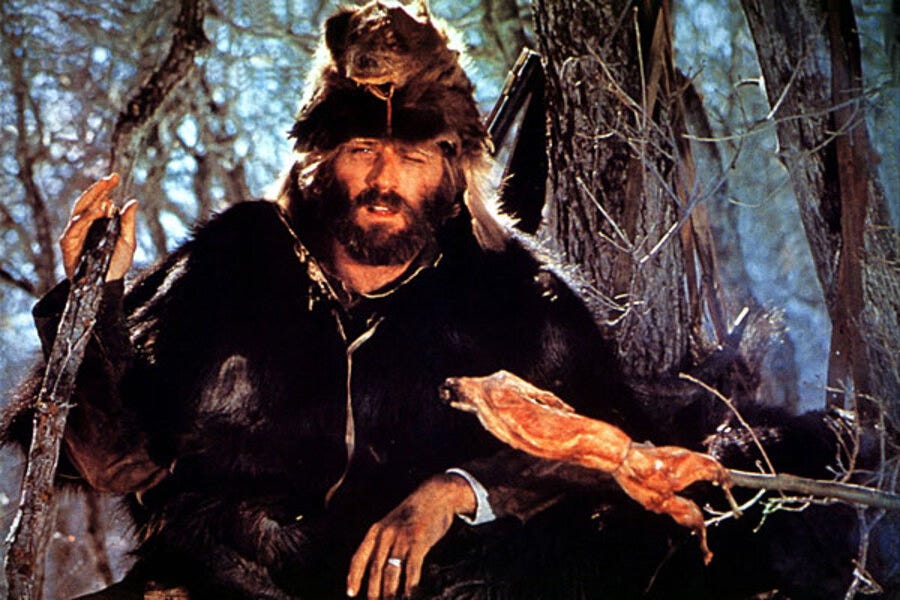
Robert Redford donned furs in the bitter cold to play “Jeremiah Johnson” in 1972.
In the novel, Fisher’s main character is named Sam Minard, a red-headed giant of a man with a killer’s instinct and a poet’s sensitive soul, who likes to whistle tunes from Classical composers as he gallivants across the grandeur of the Rockies. That is when he’s not killing and scalping Crows warriors, his sworn enemies.
Fisher brings in troves of research on the lives, times and attitudes of the solitary trappers known as Mountain Men, who preceded the white settlers into what was Indian homelands in the 1830s.
Fisher modeled his character after a man named Jeremiah Johnson, also known as “Liver-Eating” Johnson. In real life, Johnson was said to have lost his wife and an unborn child to a group of Crows when he left them to trap a beaver. Johnson embarked on a vendetta, killing some 300 Crows over a bloody career, scalping them and eating their livers.
Vardis’ novel is very much an artifact of its time in the mid-60s, even looking back to a previous century. I had not remembered the casual racism among the mountain men with their off-handed remarks with the n-word, nor Fisher’s own mixed attitudes in his omniscient narration. He’s either looking at Native Americans as superstitious and childish, or elevating them into Noble Savage status.
Unfortunately, none of his Indian characters come across as fully developed as his Mountain Men, who often seem silly and outlandish themselves, with quaint dialect out of Mark Twain.
Fisher himself is largely forgotten, though he was once known as the Dean of Western Letters, with 36 books to his name before his death in 1968.
But Fisher doesn’t whitewash or romanticize the violence of that era. I had forgotten the jolting opening of his novel. Sam rides up on a strange battle between two unlikely and mismatched opponents, a 1000-pound grizzly bear trying to ram his snout and jaws down a hole after a small badger. The angry badger latches onto the bear’s nose and won’t let go, until the infuriated bruin rips his assailant to pieces. “Like a prince of dignity overwhelmed by disgust, it flung the bloody pieces to the earth and still crying like a child with a broken heart, it sank soundlessly to front feet and loped softly away into a river thicket.”
Sam rides over to find the bear’s nose still in the badger’s bloody jaws.
Wooed by Fisher’s lyricism, I suppose I raced through all the blood and gore and racism. I was thrilled by Fisher’s paeans to Wilderness with Sam Minard striding through rainstorms atop high mountains, roaring out his gratitude to God’s Creation.
Redford’s slightly gentler version and its soaring cinematography captured my adolescent heart. we certainly didn’t watch Redford scalp his foes or cut out or eat anyone’s liver. In my Boy Scout troop, we adopted the lingo of Will Geer and Redford’s stoic mountain men, calling each other “Pilgrim.”
Fisher’s violent novel is part of the revision of the Western myth pitting Cowboys against Indians, white hats versus black-hatted villains. In 1969, Sam Peckinpah painted blood in technicolor with the final shoot-out of The Wild Bunch. Twenty years after “Mountain Man,” Cormac McCarthy publishes Blood Meridian, a beautifully written but brutally plotted novel about a gang of scalp hunters ranging across the Southwest, led by a brilliant yet evil giant known as the Judge. Liver-eating Johnson would have fit in well with that crew of stone cold killers.
Leonardo DiCaprio
And Fisher does mention the storied Hugh Glass, the trapper left for dead by his comrades after a grizzly bear attack and who crawled hundreds of miles to seek his revenge. Leonardo DiCaprio was following in Redford’s footsteps, when he won his first Oscar for the 2015 movie The Revenant, based on the Glass legend.
The violence reminds me of D.H. Lawrence’s appraisal of the American character, especially as it plays out in our epic Western myths in books and movies. Lawrence nailed us in the novels of James Fenimore Cooper, especially Last of the Mohicans. “But you have there the myth of the essential white America. All the other stuff, the love, the democracy, the floundering into lust, is a sort of by-play. The essential American soul is hard, isolate, stoic and a killer. It has never yet melted.”
Hard to argue with the curmudgeonly Lawrence with all that is happening in our county these days.
Redford would go on to become a movie legend before his recent death at age 89. I can see him almost reprising his Jeremiah Johnson role in his 2013 film All Is Lost, about a solitary sailor whose sailboat is damaged by a stray shipping container on the high seas. Redford is alone in the movie, hardly talking with only 50 words of dialogue, mostly relying on action and facial gesture to relay his brave efforts to survive against all odds.
That was at the heart of “Jeremiah Johnson” for me, a man braving the elements and appreciative for the joy to be found even in hardships.
By the end of Fisher’s novel, we do see that Sam has lost his taste for revenge and endless war and makes peace with the Crow chief and with himself. He heads back to the geysers of what would later become Yellowstone National Park, more eager to hear the birdsong that outdoes Beethoven in the heart of this mountain man.
I had no idea this was based on a novel. Or if I did, I’d completely forgotten.