Time to Herself
A short story about revisiting your past

Water boiling on the stove, the phone ringing; the daughter pulling at her skirt, pestering her once more to french braid the doll’s synthetic blonde hair; the son at the top of the stairs, at the top of his new voice, wondering the whereabouts of his scout uniform in the endless cycle of laundry; and the husband not helping matters by answering the persistent telephone and the telemarketer she had hung up on three times already this week, who was pitching the newspaper she once read, wanted to read, had no time to read, let alone recycle.
The oven clock that always loses time shows her home for all of seventeen minutes.
She burns herself, transferring pot to sink to drain the overcooked pasta, steam rising in her face. Her daughter’s wheedling. Her son’s shouting, her husband who won’t hang up, who will never hang up. She slaps away her daughter’s insistent hand. Barbie lands in the puddle of pasta water on the chipped linoleum. “Not right now,” she meant to say, but hears herself scream: “No!” She wheels from the sink, faces her family, freezes them into stone, her thoughts like snakes shooting out her throbbing skull. They recognize her for the Monster Mom she truly is.
Jim hangs up the phone, rescues Barbie from the floor, takes Katy to her place at the table, tells Kevin to cool it. “Keep your pants on, kiddo, we’ll find the shirt after we all sit down and have this nice meal your mother has made us.” The patient husband reassures their startled children, makes time go forward, while she stands in the fluorescent glare of her kitchen, reverberating.
Long married, the mother of two, far too rutted in her career path to turn back now, settled, that word she would have never thought to call her life, Val Parker has finally found herself saying “no.”
Later in bed, Val tried to explain, to apologize. “I’m sorry. It’s the job. It’s everything. I just can’t think.”
What she found hard these days was simply catching her breath. Her lungs seemed to have sprung a leak; she never could find a full, deep breath of air. She panted through the hours of her day, her pulse racing at stoplights, late to pick up Katy at dance, drop off Kevin at Scouts.
“I know, love,” Jim said.
She lay on her side while her husband’s expert hands kneaded the tight muscles of her back, his fingers finding the excess energy trapped in the rings of bone. Val talked about getting away, reassessing her life, prioritizing what was important. Reassess, another word she never thought she’d use regarding herself.
“Go. You should, you know.”
His fingers tiptoed playfully over her hip. She hoped it would go no further than that. Fuck that. She didn’t need that. She stiffened.
He read that flinch in her and his hand withdrew. He rolled over, pulling the cover with him. “Whatever, Val.”
Much can be said for family togetherness, but more should be said for emptying a household of all its inhabitants, freeing them for a time from terrible obligations of love and nurture. Kevin off to scout camp. Jim starting summer classes. Katy, she shipped to her own mother in Philadelphia, an annual sacrifice to that shrine of china and damask Val had fled years before. Grammy would take her shopping, buy her makeup, adorable dresses, charm bracelets. Katy, the perfect girl’s girl Val never was, loved it, loved that harridan who Valerie had never failed to disappoint when she was growing up.
Val had time coming herself, two weeks, not counting the days rolled over from last year, not that anyone ever used all of the vacation allotted by the non-profit agency that aided unwed teenaged mothers. Still, the pregnancy rate couldn’t climb higher, the office wouldn’t collapse if she took a long weekend. A few nights away from her real life, perhaps she could reach some conclusions, or at least right her listing sense of self.
She packed their second car with an overnight bag. She gave her husband’s cheek a dry peck. He smiled and waved as she backed out the driveway. He was probably glad to see her go. At the top of the cul-de-sac, she braked, stared into the rearview mirror. Jim was ringing his mistress, Kevin getting high with the Second-Class scouts at camp, Katy likely picking out her gown and escort for her debutante ball. Turn back, now, no, too late.
She didn’t recognize the feeling at first. Then it came slowly, almost a gasp, a relief from the tightness of her ribcage. She was free for the next four days.
Val merged onto the turnpike, then took the interstate up the valley toward Vermont. Driving north, concrete curves and straightaways in endless repetition, the amnesia of the interstate. The high walls buffering the traffic from neighborhoods fell by the wayside, then, slowly, the land shifted. Solitary boulders stood by the highway’s shoulder, fallen from the blasted cliffs.
As she drove, she played her old divas, Linda Ronstadt, Patsy Cline, Billie Holiday, the soundtrack of her youth kept in a shoebox. Val embarrassed herself, reminded of her mother swooning to Big Band swing while driving the Lincoln to visit her father’s grave. Besides, the tapes were so old, they broke when Val tried to rewind. Static hissed through the speakers.
She snapped off the stereo, and drove in silence, alone now for more than two hours. What was that? Yes, she heard herself thinking. With each mile rolling up on her odometer, she felt a year rolling off her. She cranked down the window and let the hot wind fill the car, roaring around her ears, ruffling her blonde hair at the nape of her neck. She had on sunglasses. She looked good in the rearview mirror.
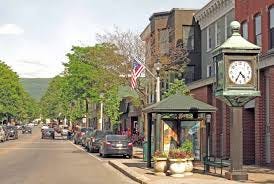
Things looked different driving into downtown Burlington; more stores, more traffic, but she had to admit it had been almost twenty years. Drifting through the busy intersections, the old turns of her life, she caught glimpses of the waterfront, the great lake stretching to a hazy range on the distant shore. She once knew her way around town but had had downloaded Internet directions to her bed-and-breakfast to be on the safe side. She didn’t remember this particular street, even though all the houses had been here in her time, rambling Victorian manses that once housed the counterculture, psychedelic flophouses where long haired men and women in peasant blouses had made love and grown pot in the attics, now beckoned to balding men and thickening matrons seeking nothing more hallucinatory than fall foliage.
The woman she had spoken to on the phone showed her to the third floor, to what must have been a little girl’s bedroom or even a servant’s cell with its dormered windows and the sloping ceiling she could almost touch above her bed.
“Oh, how lovely.” Val bounced on the edge of the bed like Katy would have. She stifled the delicious urge to squeal.
“It’s yours if you want, the whole house,” the innkeeper said. No older than herself, the woman was slumped in the doorway, her arms crossed warily.
Suddenly, they were sharing a confidence Val neither expected nor welcomed. The woman and her husband had come years before and bought the house, lovingly renovated it, weeks of sanding and stripping, finally finished, opened for business. The nameless He had fallen for someone else, a guest. Now the woman wanted to tear the house down, run through the rooms, raking the pretty wallpaper with her fingernails.
“No one knows what it takes to keep a place like this going. Strangers coming to stay night after night.” the innkeeper said sadly, then she politely, professionally brightened. “But you’re all set. We have pastries and coffee down in the parlor starting at seven. Let me know if you need anything.”
Alone in her room, solitary, Val wished she could share this rare feeling with some one. It was so pretty, this room to call her own for the next four days, she wanted a picture of it. But she had packed no camera. She could buy a postcard but to whom would she send it, and what could she say on the back of a three-by-five slip of paper about why she was here?
She unpacked her tote, arranged her clothes in the dresser drawers of the old but not antique bureau. She had packed light. No laptop, no cellular phone, lest she be tempted to check her e-mail or voice mail. She brought pens and legal pads for her reassessment, and then, at the last minute, rescued from the closet a journal of her time in this town. She flopped across the bed and opened the blue marbled cover, leaving through the stiff pages, her old life:
I am not a person who deals well with parties, particularly after a night of work and on my feet. Met one interesting man though. Not what I thought of as my type. He was tall, even sitting down against the wall. Actually, he sat on the back of the chair with his feet on the seat, like a gargoyle or a bird of prey about to swoop down on the sweaty maidens. He asked me to dance. Gangly, I thought following him onto the dance floor. Then he turns into Fred Astaire. The man can dance, can actually lead. Dips, twirls, spins. And he has whipped me out into space and I swirl back into his arm, tight against his body, his chest, his arms. We’re in the movies. People are watching us. They actually applaud when the music stops. I think he said his name is Henry. Definitely Henry.
That summer seventeen years before, she had kept her journal religiously, filling the pages in between customers. The other waitresses where she worked thought she was tallying her tips, which she did, along with her passing thoughts. She noted her every expense, how much for rent at the house where she lived, how much she spent on beer and wine, worried she was drinking too much. She was saving for a car, a trip to Europe, the life to come. She worked evenings, went dancing with girlfriends, went home with boys one after the other, slept in mornings in her own bed, and rose late to drink coffee, complete the crossword and to record all that she had thought or felt in those twenty-four hours.
Val recognized her wry humor, how she so quickly sized up people and took their measure, a savvy that had advanced her career at the non-profit agency after having her kids, but now she seemed only judgmental with a tendency to quickly stuff strangers into mental boxes, close the lid and label. No more thought necessary.
She saw the girl who once was her, lounging with her hand in her chin, the book open for her thoughts, her fingers rubbing the rim of her coffee cup. Sitting in the northern sun, she turned to bronze, her hair spun to gold. She would spy boys on the street, let her eyes linger after their broad shoulders, their tight hips down the street. And when they turned the corner out of view, she found herself gazing at the great dark lake, imagined an icy plunge into its depths. She shivered with possibilities. The days were impossibly bright, the nights never long enough. She was saving for Paris. From Burlington to the boulevards. She would look at art. She would eat petit fours. She would meet a French boy, no, a Frenchman with a chateaux, who would know how to please her.
“Your change, ma’am.”
Her server held a plastic tray of loose coins. The girl was blonde and well-scrubbed, the image of herself years before when one was only an unannounced waitress, not a self-introduced server. What had the girl – whose name Val had automatically forgotten – what had she called her? Ma’am? As in matronly?
A metallic bitterness rising in her throat. As if the girl had made her swallow the change, one penny at a time.
“Please don’t. I’m not...” It was impossible to explain. She was tempted to stiff the girl her tip, then she put down too much money, as if trying to buy the girl’s understanding.
The trip was turning out to be a mistake. No one knew her now, no one noticed her, a single middle-aged woman hurrying along the sidewalk, pushing past window shoppers. She felt like a ghost, not visible as flesh and blood by the people who lived here now. She passed a club where she once danced, but the sound shoved out the doors seemed louder than she remembered. Music without melody and a rhythm like that of a garbage truck making the rounds of a sleeping neighborhood.
She stopped at a pay phone, dug through her purse for the calling card. Disoriented, she needed a voice from her current life. Jim would say something bland and reassuring. But after four rings, the machine answered, the friendly voice. “Hi, you’ve reached the Parkers. We can’t come to the phone right now....”
“It’s me,” she said, waiting for the damned beep. “I’m OK. I just wanted to say hey. Hey. Have you heard from Kevin or Katy? Is the house still there? You won’t change the locks while I’m away.” She paused. “Hey, I love you.” How strange that sounded, then she added, “That’s all,” and hung up. The machine now blinked its red eye in their empty house.
She hesitated in the phone booth, her palm still clammy on the receiver hung in its cradle. There was a town directory chained beneath the shelf. She opened it, searching for someone, anyone familiar, an old girlfriend from her time here. The first page she turned to, her eyes fell on his name. Unbelievable. Henry still here, after all these years. Henry Hill. It wasn’t the same number, the one she knew by heart and thought she had forgotten. It was like karma, kismet, a crossword word. Henry, her heartthrob, the best dancer she ever knew, the first unfumbling lover, a man, not a boy. He lived around the corner from where she was staying.
It was embarrassing to remember how much she loved him. Smitten was the only word. Even now she felt a pang in her chest. She crossed the street and counted the addresses. Oh God. Here was the house, No. 18. She felt like a schoolgirl, a groupie. She darted up the drive, to a vintage Volvo parked by the weathered porch. On the cluttered dash, she saw an envelope with his name. For a second, she wanted to steal his electric bill.
Later that evening, middle-aged, mature Val Parker found herself standing once again at the foot of the driveway. She walked past the car and the porch and into the backyard beneath the shadow of the spreading oak. She was tempting fate, or at least ridicule. Only a crazy woman stands in people’s back lawns at night, spying into their lighted windows. Still she stood there, listening, waiting until it came, like an answer, and made her throat tighten.
She heard his laugh, a goofy, high-pitched cackle. She had loved how Henry laughed, how it shook his whole body, turned his face red until she thought he was choking to death, and people stared at them in public places. They had laughed in bars, and in bed, and driving around town and through the beautiful country. It was impossible but it was him, years later, Henry still laughing. Mosquitoes were making mincemeat of her calves, once the slim muscles of a girl who loved to dance. They were drawing blood, her blood, but she could not pull herself from the past. She stood in the dark, holding her breath, waiting for his laughter.
Henry the dancer called me finally. My roommate took the message. “May I have the next dance?” Just tell her that, he said. Roommate sounded envious. I called back and we decided on dinner. Afterwards, a walk by the lake. How terrible first dates. I wish sometimes that we could just strip ourselves naked. This is the part I love best. No need for words. How shy he seemed. He slips under the sheets with me, and we move together so sweetly. I love how he laughs. We were so sweaty. We danced to Little Richard, to Talking Heads, to Rolling Stones, to whatever they played. And then we walked home. I remember his hand at my back that touch, there was an electricity between us. No man has ever touched me there, so tenderly. The small of my back. He belongs there.
At a sidewalk café, she watched women like herself eye storefronts stocked with quilted coverlets, overpriced local crafts, knickknacks of Vermont they did not need. They darted in and emerged with their loot in string bags, loaded their luxury cars to drive back to the City. Weekenders, the people she used to despise as a waitress, even as she counted her tips, hoarding loose change to take her to Europe. They reminded her of her mother. Crossing nervously her feet beneath the table, she kicked the paper bag filled with guilty gifts. For Katy, a nice doll, A Swiss Army knife for Kevin. Nothing for Jim, a man so contented he was impossible to buy for, but in the bookstore she found something for herself, a handmade journal.
She dated the first blank page and wrote her unusual location, then had gone blank herself staring at the lined page for twenty minutes, gnawing the cap of the pen. She thought of a thousand things to say about her life, but in the end, closed the book and put away the pen. She had fallen out of the habit. The hours and pages and paragraphs she had spent recording the weather and her own fickle moods seventeen years before had been pared down. Now she noted sunshine and rain, blue days and sunny dispositions in her electronic organizer. Her quotidian life could be summoned with a keystroke command: “Good Day” or “Hard Going today” or “Today Sucked.”
Still thinking over her lost days, she gathered her treasures from beneath the table, turned and collided with a passerby. Instinctively, she tightened. Her bag spilled across the sidewalk.
“Why don’t you...”
“Sorry. Sorry. Let me help.”
The man knelt apologetically, as she snatched the journal, the doll, the knife from his unhelpful hands. He had on sandals with rag wool socks. Dark hairs running along his shapely shins. He wore a white shirt, the sleeves rolled neatly. She looked into his face, the graying beard, the wrinkled eyes.
“Sorry,” he offered again.
“Henry?”
“Jesus, Val?”
They rose as one, laughing in disbelief. It wasn’t possible. Encounters like this happen only in real life, never in stories. No one would believe her, she thought, then she was thinking that she couldn’t tell Jim this. She would tell no one.
“It really is you, isn’t it?”
No, she thought. “Yes,” she said.
They did their awkward dance on the sidewalk and decided on a mutual hug. He patted her back softly. She squeezed his lean ribs, smelled the scent of his chest.
“My God, I can’t believe it. Val. He held her back at long arm’s length, and said her name, “Val,” more than a little wistfully, she thought.
“How long has it been?” he asked.
“Seventeen years,” she said.
They walked to his house, but he did not invite her inside, but left her with the propriety of the front porch while he went in for some beer. She wondered what his life was like inside, still messy? He returned with two cold sweating bottles, and played the host, offering a ratty rattan chair. Henry leaned back in his chair, balancing himself with one lanky leg against the porch post. Val hiked her white legs up on the rail. They did not look so bad from this angle, she smiled to herself, then she turned that smile toward Henry.
Strange how little time it takes to fill in the details of the past two decades. She opened her wallet and showed the pictures of her husband, her two children to her old lover. She talked about her job. She mentioned her mother, still in Philadelphia.
“You swore you’d never be that woman.”
She drank him in. “Henry Hill, oh, it is definitely you.”
He didn’t laugh now, but smiled, wistfully, she thought. “Tell me about your husband.”
“Jim.” Val sat up, her feet on the floor instead of up in the air. “Oh, he’s a good man.”
After the obligatory post-college backpacking about Europe, she met and married Jim Parker, a graduate student in Boston, who became a very good English teacher adored by his girl students. Assistant headmaster at a private school, not the most prestigious but academically strong. Of course, without the endowments and the through-the-gabled-roof tuition of the better known boarding schools, they paid their faculty poorly.
“We joke that we’re only pretending to live in Connecticut. Any day now they’ll pass a law for a minimum bank account and run us out of the neighborhood.”
She could feel herself frowning, the worry lines of her mother wrinkling her mouth. She quickly gulped more beer. “And you, Henry Hill, what’s happened to you?”
He had never quite finished the graduate degree, hung around the university for years, but never sat down long enough to write the dissertation. He still had all the notes, maybe someday. He’d just closed a business on Main Street, a little comics shop. She might have passed it. Construction sometimes in the summer, though he was getting too old for the long summers, the trickle of extra income teaching Transcendental Meditation.
“Oh, I remember,” said Val. “Did you ever learn to fly?”
He shook his head in all seriousness. Once he’d shown her how the gurus could levitate from a lotus position. He called it flying, although it looked suspiciously like he was hopping on his butt. “I went out to Iowa one summer and took classes at Maharishi U.,” he admitted. “It takes years.”
He sank deeper into his chair. Val felt the same weight, too much gravity, so many years. Meditation hadn’t saved his marriage, but kept him sane through the divorce and helped him deal with his son. Named Dylan, fifteen now. Purple hair cut, nose and eyebrow rings, super smart but suspicious of affection, although Henry tried on his alternate weekends of custody. Besides splitting a son, he shared rent and bed with a Dutch woman, a massage therapist. He said nothing more about her, but the strange gesture of his head and shoulders, somewhere between a shrug’s resignation, a nod’s curt knowledge, said everything.
They sat on the porch and fell silent. The beers grew warm in their hands. A breeze blew across the yard, flipped the underside of the sycamore leaves and raised chilblains on Val’s bare legs. The wind came from the dark lake, the reservoir of glaciers melted ages ago, an icy reminder of the returning cold.
Val shivered and blew her own odd note across the lip of her bottle, then swallowed a bitter mouthful. Instead of a Dutch masseuse and Jim, instead of difficult Dylan, and her babies, Kevin and Katy, it may have turned out all so differently. Her heart raced right to the edge of a void in her gut, and teetered there. She did not know what she wanted.
She stood and heard her knees crack, betrayed by joints that once had been supple. “I really must be going. This has been so nice.” She swore she would never be this cold and distant, but too late. Val heard her mother’s voice coming out of her mouth.
Henry stood too, poor man with battered hands and a helpless look, still a good dancer, a decent man without a clue to his life. They hugged and swayed slightly as if listening to some tune out of their past. Blushing, she craned her neck and brushed his lips with her own. She had forgotten what it was like to kiss a bearded man. If he had asked her inside then and there, led her by the hand, she might have gone. But he let go and they stepped apart into their separate lives, their histories, their futures yet to come.
“We should keep in touch,” Henry said.
“Yes, of course.” She found a business card and on the back scribbled her home phone. He slipped the card into his shirt pocket, patted it with a knowing smile. She knew Henry; he would lose it.
On the first page of her new book, she jotted his name and number. So it would be an address book, not a journal after all.
“You’ve still got your writing, I see.” His smile was shy in his graying beard.
“Oh, this.” She stuffed the book in her bag.
“I saw you for weeks at that café, always with a journal. I thought you were a novelist. You used to get out of bed and write things. I wondered what you put down about me.”
“Only good things, Henry.” She laughed as she lied.
She had not written everything, that was the problem, she decided later, walking back to her bed and breakfast along sidewalks busy with summer visitors. Festive crowds in shorts and sandals and sneakers hiked the asphalt and cobblestones, in search of New England. What had she been thinking, what had she thought she would find, poking about her past? She had her life, her children, her work, and Jim, always smiling, always understanding while she played the moody one in their marriage. He was no Henry, thank God.
Jim would smile at a goof like Henry, his long legs folded into a lotus position, trying to clear his long-haired head of the laws of gravity. She laughed, first at Henry, then, more bitterly, at herself. Weren’t her journals the biggest joke, nothing but the notes of a flighty girl? She had breezed through the unpleasant, edited her life to fit the nicely lined pages. What about the part she left out, that pregnant part?
In the same casual way they had talked over the tab for dinner or drinks, Henry offered to split the bill for what she finally decided needed to be done. That, they did not talk over, that was her deal and hers alone in their unspoken agreement. He had driven her to the clinic. Not so many years before and this would have been illegal, unthinkable, dangerous. But Henry could go no farther with her. He waited in the car, afraid to be the only man sitting in a room of such women. But when she came back out, she found him lying in the grass beside the car.
“So soon?” He got to his feet, brushing stems from the frayed sleeves of his white shirt. Had he fallen asleep?
They drove back to Henry’s apartment. She went into the bedroom and lay down. The rickety springs shifted as he got into bed and held her. There were no tears in her. They seem to have been surgically removed along with the fetus.
But she heard him crying. “You wouldn’t have kept it? We couldn’t have?”
You sonofabitch, you never asked. If you had only asked. You selfish bastard. Why ask now? But she said nothing.
The light slanted through the green trees of Vermont waving outside her window. The season was changing. Soon winter would come. Lying this close to Henry, she felt herself moving miles away, already driving away..Along the road, the hills flashed glimpses of granite, vestiges of the glaciers that had shaped this world in ancient advances and retreats, leaving their long scars
Three days in Vermont and enough lattes to last a lifetime. She emptied the dresser drawers, packed the suitcase, set it by the door. She studied the room, the solitude she was surrendering a day early. She stood a long time at the window overlooking a dying elm tree and the play set in the yard next door.
At the fateful pay phone again, she punched in the complicated numbers of her calling card. She shaded her eyes against the glare off the lake.
“Hey, it’s me,” she said when he answered. It was good to hear his calm voice.
“You had enough time to think?”
Yes, she was thinking. That night in bed, his strong hands kneading her back, she would turn to him. He would raise himself over her, a dark hovering angel, press into her. “Have you reassessed your life?” Yes, oh yes she imagined herself melting, moving beneath him.
“What?” On the phone, Jim was saying something she didn’t quite catch. “I’m sorry. “What did you say?”
“I said it hasn’t been the same here. I miss you.”
“Me too,” she said softly.
She checked the rear-view mirror and drove on, not looking back. In the seat beside her, the new journal, unmarked, undefiled, lay on the faded cover of her old one. She resolved to write in it, write more, and more than weather reports and passing moods, but about progress, what she felt, how far she’d come.